
What Every Homeowner Should Know Before Getting a Concrete Patio


A well built concrete patio in Des Moines can last 25 to 30 years or more. A poorly built one can start showing real problems in as little as three to five. The difference almost always comes down to what happens before the concrete truck arrives.
This guide covers what Des Moines homeowners should understand before committing to a patio project. We’ll go over how the installation process actually works, what our winters do to concrete and how proper installation fights back, what finish options are available, and questions we frequently get from our customers. If you are early in the research process, this is the right place to start.
Why Concrete Is One of the Best Patio Materials in Des Moines
Concrete holds up well in Des Moines for the same reasons it gets a bad reputation elsewhere: it is unforgiving of shortcuts. When the installation is done correctly, a concrete patio is one of the most durable outdoor surfaces available. It handles foot traffic, furniture, grills, and the full range of Midwest weather without the ongoing maintenance that pavers or wood demand.
Pavers shift and settle over time, especially in soil that moves with frost. Wood decks require regular sealing, staining, and board replacement. A properly installed and sealed concrete patio needs comparatively little attention year to year, and it does not have gaps for weeds, soft spots from rot, or individual pieces that come loose.
Concrete is also one of the most versatile surfaces available. The same material that makes a clean, practical broom-finish slab can be stamped to look like flagstone or slate, colored to match your home’s exterior, or finished with exposed aggregate for texture and visual depth. You are not limited to the gray slab most people picture when they hear the word concrete.
The catch is that all of those advantages depend on the installation being done right. The material itself is not forgiving of poor base preparation, the wrong mix, or skipped steps during curing. In a climate like Des Moines, those shortcuts tend to show up fast.
What a Proper Concrete Patio Installation Actually Involves
Most homeowners focus on the finish and the price. What actually determines how a patio performs for the next 25 years happens before the concrete is ever poured.
Excavation and base preparation is the foundation of everything. The existing soil is excavated to the required depth, the subgrade is compacted, and a gravel base is installed and compacted before any concrete touches the ground. For residential patios in Des Moines, a properly compacted gravel base of at least four inches is standard. This base gives the slab a stable, well-draining platform that resists movement when the ground freezes and thaws. A contractor who skips adequate base preparation is cutting the single most important step in the process.
Concrete mix design matters more than most homeowners realize. Not all concrete is the same. For exterior slabs in Des Moines, a minimum of 4,000 PSI concrete is appropriate, and the mix should include air entrainment. Air-entrained concrete contains microscopic air bubbles distributed throughout the mix that give it room to expand and contract without cracking as temperatures change. In a climate with significant freeze-thaw cycling, air entrainment is not optional. The water-cement ratio also matters. Too much water weakens the mix and increases the risk of scaling and surface deterioration over time.
Thickness is another variable that gets underestimated. Most residential concrete patios in Des Moines are poured at four inches. If the patio will see any vehicle traffic, or if it connects to a driveway, five to six inches is a more appropriate spec.
Control joints are the planned lines cut or tooled into a concrete slab that give it a predetermined place to crack rather than cracking randomly. Concrete shrinks slightly as it cures, and it expands and contracts with temperature changes throughout its life. Without control joints placed at proper intervals, that movement produces unpredictable cracks across the surface. With them, any cracking that does occur happens at the joint, where it is expected and far less noticeable. Spacing and depth of control joints are details that separate contractors who understand concrete from those who are just pouring slabs.
Expert Insight: One of the most common issues we see with failed patios in Des Moines is not the concrete itself but what was done before the pour. Thin gravel bases, uncompacted subgrade, or skipping the base entirely might save a few hours on install day, but the patio will show it within a few seasons. Freeze-thaw cycles in Des Moines are hard on any slab sitting on unstable ground. Proper base prep is not where you want a contractor to cut corners.
What Des Moines Winters Do to Concrete and How Good Installation Prevents It
Des Moines sees an average of 30 to 40 freeze-thaw cycles per year. A freeze-thaw cycle occurs when temperatures drop below freezing and then rise above it again. Water expands by roughly 9% when it freezes. Any water that has worked its way into the pores of a concrete slab will expand when it freezes, putting internal pressure on the concrete from within. Over many cycles, that pressure causes surface scaling, spalling, and eventually cracking. This is not a reason to avoid concrete. It is a reason to make sure the concrete is mixed, installed, and sealed correctly.
Air-entrained concrete addresses this directly. The air voids in the mix give water somewhere to go when it expands, relieving the internal pressure that causes damage. Properly air-entrained exterior concrete, mixed to the right PSI and water-cement ratio, is specifically designed to handle freeze-thaw conditions.
Surface sealing adds another layer of protection by reducing how much water penetrates the slab in the first place. A penetrating silane or siloxane sealer absorbs into the concrete and creates a water-resistant barrier without changing the surface appearance. Film-forming acrylic sealers sit on top of the surface, can enhance color and sheen, and need to be reapplied every two to three years. Both have their place depending on the finish and the homeowner’s preference. What matters is that sealing happens, and that it continues on a regular schedule.
Drainage is also worth considering at the planning stage. A concrete patio should slope away from the house at a minimum of one-eighth inch per foot. In Des Moines, standing water on or around a patio accelerates freeze-thaw damage significantly. A patio that drains well is a patio that lasts longer.
De-icing salts are a separate topic worth understanding. Sodium chloride and calcium chloride, the most common products used on driveways and walkways, are hard on concrete surfaces. They accelerate the freeze-thaw damage cycle and can cause surface scaling even on well-installed slabs. Sand is a safer option for traction on a concrete patio in winter.
Finish Options for Concrete Patios in Des Moines
The surface finish on a concrete patio affects how it looks, how it performs under foot traffic, and how much it costs. Understanding the options before you get quotes helps you evaluate what you are being offered.
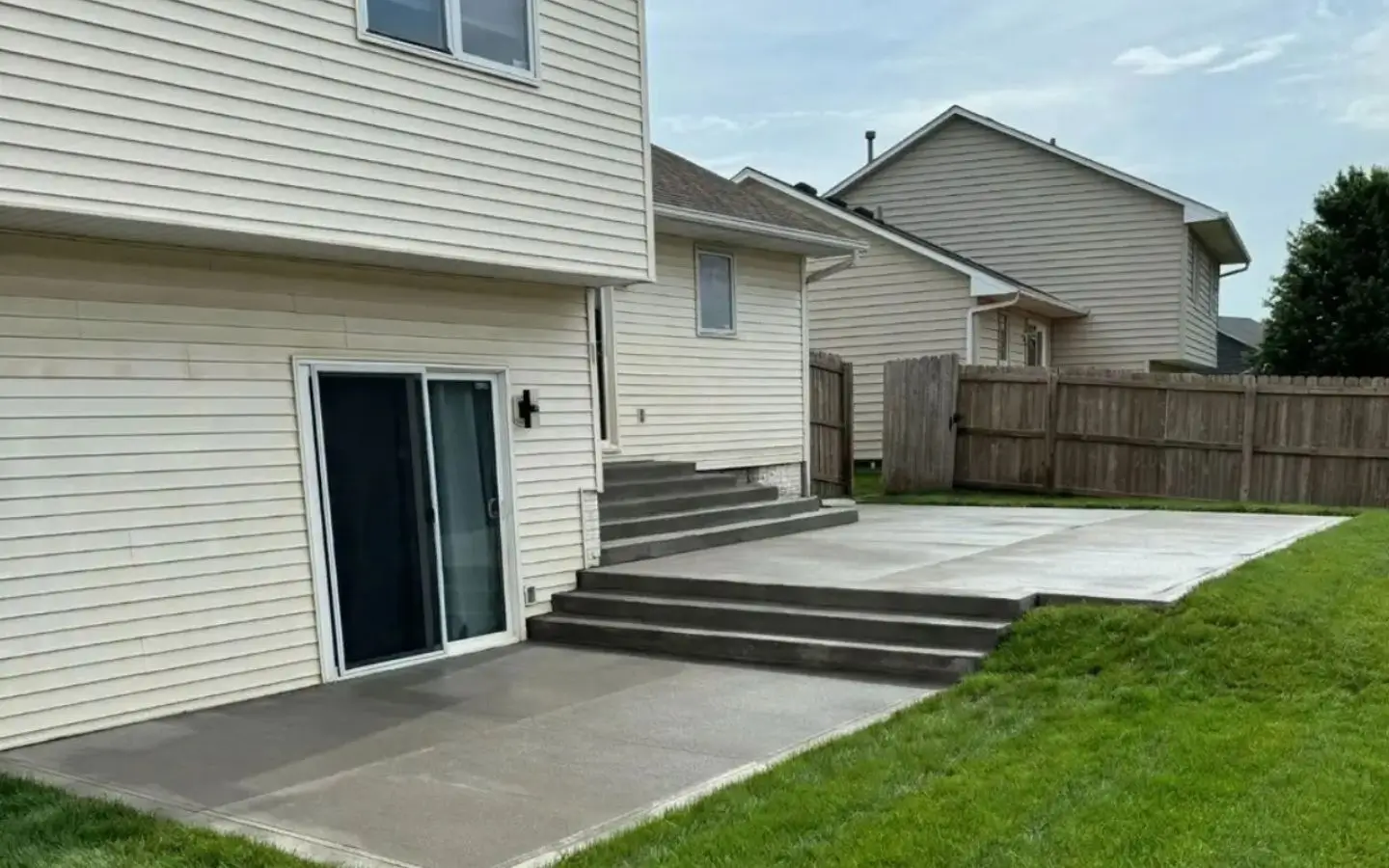
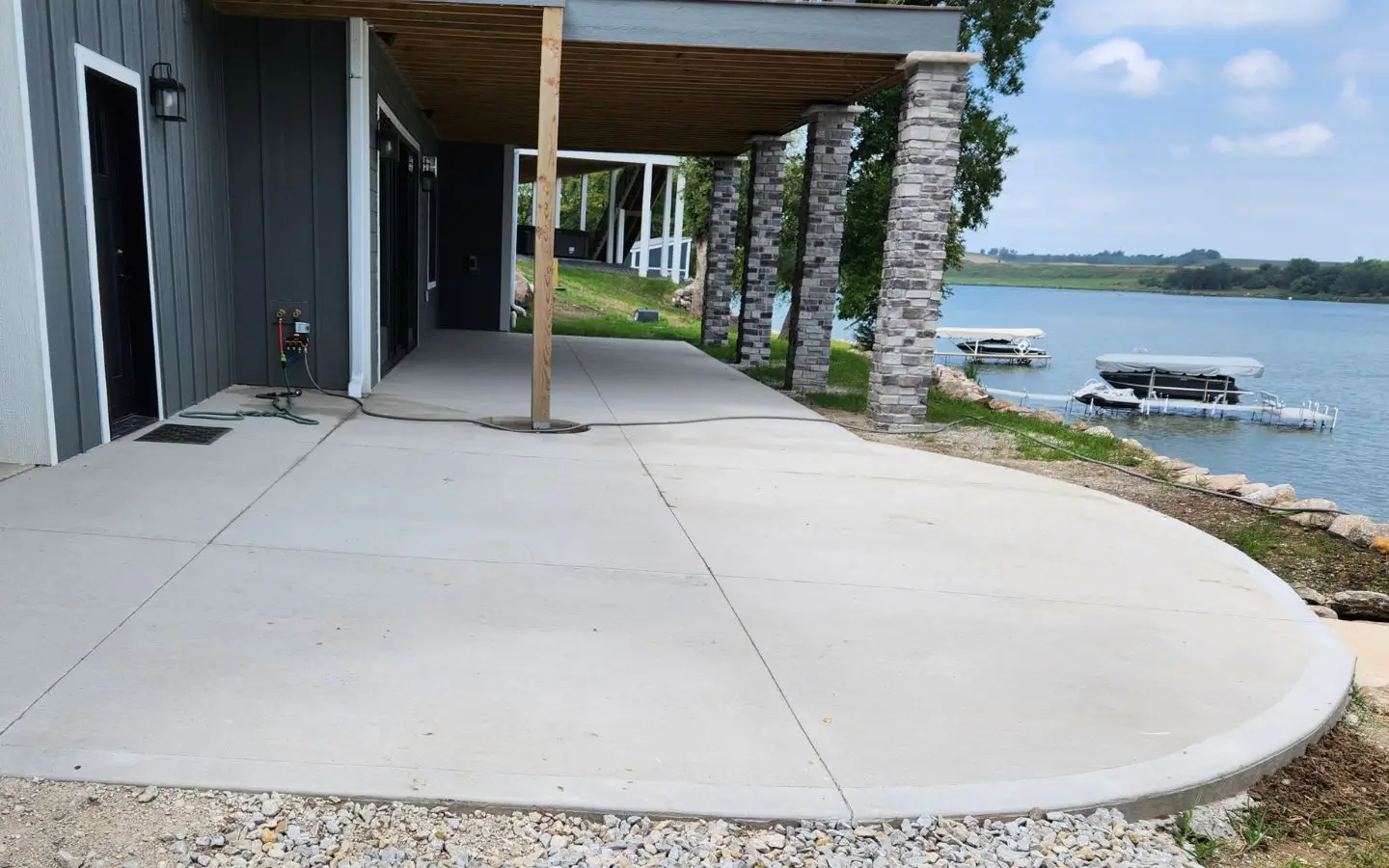
Broom finish is the most common finish for residential patios. After the concrete is poured and screeded flat, a broom is dragged across the surface to create a textured pattern that provides traction. It is practical, durable, and cost-effective. For a patio where function matters more than a decorative look, a well-executed broom finish is a perfectly good choice.
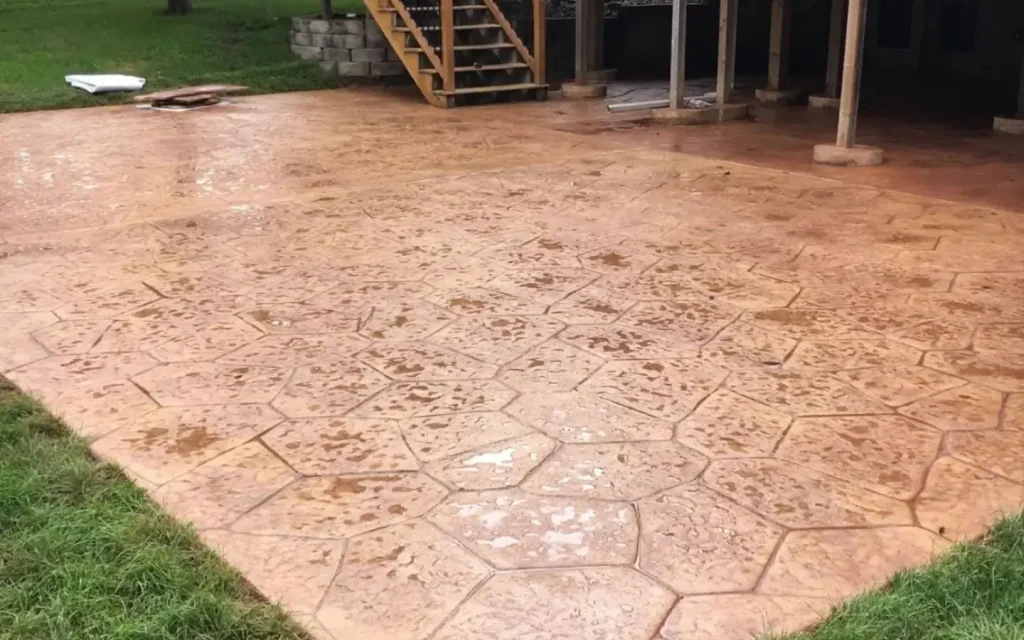
Stamped concrete uses textured mats pressed into the wet concrete surface to create patterns that resemble natural materials: flagstone, slate, brick, cobblestone, and wood plank are among the most common options. Color is typically added to the mix or applied as a surface release agent during stamping. Stamped concrete creates a high-end look at a fraction of the cost of the natural materials it mimics, and unlike those materials, there are no joints for weeds or uneven pieces to trip on. It does require sealing and occasional resealing to maintain the color and surface protection.
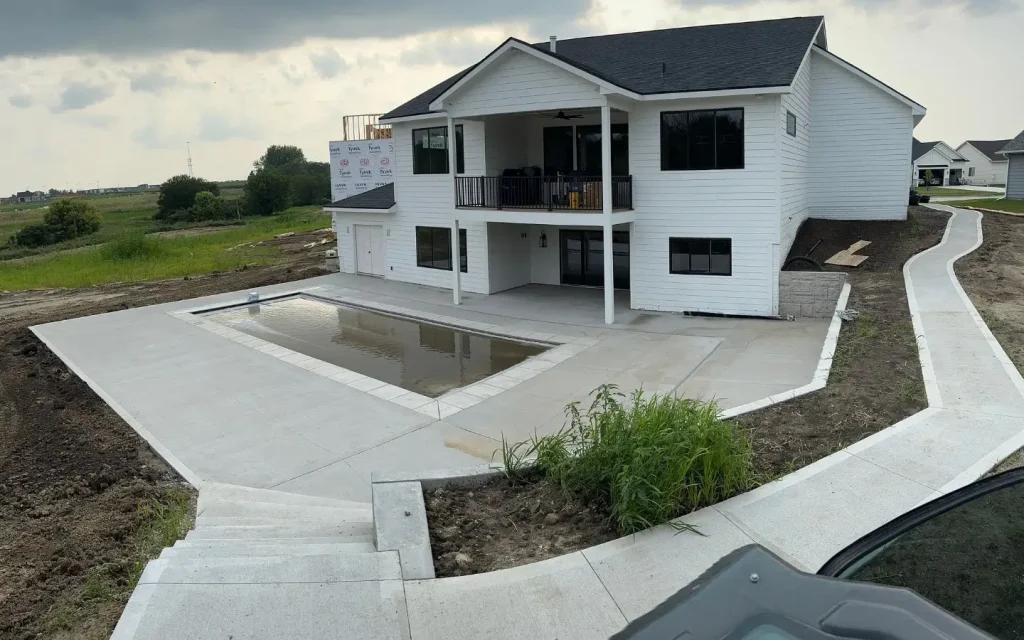
Exposed aggregate involves removing the surface paste of the concrete before it fully cures to reveal the stone aggregate below. The result is a textured, natural-looking surface with good traction. It works well as a pool deck or anywhere you want visual interest without the maintenance of stamped concrete.
Integral color and acid staining offer ways to add color to a standard slab. Integral color is mixed into the concrete before pouring. Acid staining is applied after the slab has cured and creates a variegated, mottled effect that looks different from flat paint or dye. Both change the appearance of the slab significantly and are worth seeing examples of before committing.
If you are considering stamped concrete, request photos of completed projects in Des Moines specifically. Stamped concrete requires skill and experience to execute well, and the quality varies considerably between contractors.
MR Concrete Iowa offers free on-site quotes across Des Moines and Central Iowa.
Request Your Free QuotePlanning Your Patio: Size, Drainage, and Permits
A common question is how big a patio should be. The honest answer is that it depends on how you plan to use it. A patio that will hold a dining table for six, a grill, and some lounge chairs needs more square footage than most people initially plan for. The general guidance is to mock up your furniture in the space before committing to a size. Most homeowners who size down regret it. Most who size up do not.
Think about how the patio connects to the rest of the yard and to the house. Does it need to accommodate a door swing? Will there be a step down to grade, or will the patio be flush with the lawn? Is there a gate, a fence line, or landscaping that affects the footprint? Drainage should be designed into the slab, not left to chance. The patio should slope away from the foundation at a consistent grade. If water currently pools in the area where the patio will go, That needs to be addressed as part of the project rather than assumed to resolve itself once concrete is in place.
On permits: most residential concrete patios in Des Moines do not require a building permit, but the answer depends on the municipality and the specifics of the project. A patio that is attached to the house or above grade may trigger different requirements than a ground-level slab. It is worth a quick call to your local building department before the project starts rather than discovering a requirement mid-build. A legitimate contractor will be able to tell you what is typically required in your area and handle the paperwork if a permit is needed.
Expert Insight: The quote itself tells you a lot. A detailed written quote that breaks down demolition, base preparation, concrete spec, control joints, finishing, and sealing is the product of a contractor who does this work systematically. A quote that just says “concrete patio, X square feet, $Y” with no detail leaves you no way to evaluate what you are actually getting for the price. We write detailed quotes because homeowners deserve to know exactly what they are paying for before a single shovel goes in the ground.
How Long Will a Concrete Patio Last in Des Moines?
A properly installed concrete patio in Des Moines should last 25 to 30 years or more with basic maintenance. That means the right PSI, air-entrained concrete, adequate base preparation, proper control joints, and sealing on a regular schedule.
A patio that skipped one or more of those steps will show it. Scaling starts when the surface concrete is not properly air-entrained or when de-icing salts are used over years. Random cracking develops when control joints are missing or base preparation was insufficient. Heaving and settling occur when the gravel base was too thin or the subgrade was not compacted.
The variables that most affect longevity are all installation decisions, not product limitations. Concrete is a durable material. Its lifespan on a given project is mostly a function of how it was installed.
Maintenance on a well-installed patio is straightforward: keep it clean, reseal it every two to three years if you are using an acrylic sealer, and avoid chloride-based de-icing products in winter. That is a low bar for a surface that performs well for decades.
Working on a Concrete Project?
A concrete patio is one of the more permanent improvements you can make to your outdoor space, and it is one where the quality of the installation is not visible at first glance. The base preparation is underground. The mix design is in the truck. The curing happens after you have left the job site. This guide exists because homeowners who understand what good installation looks like are better equipped to hire someone who actually delivers it.
MR Concrete Iowa has been installing concrete patios in Des Moines since 2016. We offer free on-site quotes, detailed written estimates, and no-pressure consultations. Request your free quote today and we’ll come out, look at your space, and give you a clear picture of what the project involves.
Frequently Asked Questions
How much does a concrete patio cost in Des Moines?
Concrete patio costs in Des Moines typically range from $6 to $12 per square foot for a standard broom-finish slab, and $12 to $25 or more per square foot for stamped or decorative finishes. The variables that affect cost include the size of the patio, the finish type, whether demolition of an existing surface is needed, and site-specific factors like access and drainage requirements. The best way to get accurate pricing for your project is an on-site quote, since cost guides can only approximate what your specific job involves.
How long does it take to install a concrete patio in Des Moines?
Most residential concrete patios are completed in one to two days. The pour itself typically takes a single day for a standard residential-size patio. Larger projects, those involving significant demolition, or stamped concrete work may take two to three days. After the pour, the concrete needs time to cure before it can be used. Light foot traffic is generally safe after 24 to 48 hours, and full use after seven days. The slab reaches its full design strength at 28 days.
Do I need a permit for a concrete patio in Des Moines?
Most ground-level residential concrete patios in Des Moines do not require a building permit, but requirements vary by municipality and project specifics. A patio attached to the house, above grade, or over a certain size may trigger permit requirements. It is worth checking with your local building department before the project starts, and a reputable contractor will be able to advise you on what is typically required for your specific project.
How thick should a concrete patio be in Des Moines?
Four inches is the standard thickness for residential concrete patios in Des Moines. If the patio will see any vehicle traffic, connects to a driveway, or will carry heavier loads, five to six inches is more appropriate. The thickness should be consistent across the entire slab, not an average that includes thin spots. Adequate thickness, combined with the right concrete mix and proper base preparation, is what gives a slab its structural integrity.
What is the best concrete finish for a patio in Des Moines?
The best finish depends on how you plan to use the patio and how much maintenance you want to do. A broom finish is durable, practical, provides good traction, and is the most cost-effective option. Stamped concrete delivers a decorative look at a lower cost than natural stone or pavers, requires periodic resealing, and performs well in Des Moines weather when properly installed and maintained. Exposed aggregate is a good middle ground for homeowners who want texture and visual interest without full stamped concrete pricing. All three perform well in Des Moines winters when the base installation is done correctly.
How do I maintain a concrete patio through Des Moines winters?
The two most important maintenance habits are keeping the slab sealed and avoiding chloride-based de-icing products. Sodium chloride and calcium chloride accelerate freeze-thaw damage and cause surface scaling over time. Use sand for traction instead. Keep the surface clean and free of debris that can trap moisture. If you have an acrylic sealer, plan to reseal every two to three years, or when water stops beading on the surface. A penetrating sealer lasts longer but does not provide the same surface sheen.
How long before I can walk or drive on my new concrete patio?
Light foot traffic is safe after 24 to 48 hours under normal conditions. You should wait at least seven days before moving heavy furniture or placing concentrated loads on the slab. Concrete continues to cure and gain strength for 28 days after the pour, reaching its full design strength at that point. In cold weather, curing takes longer, and the slab should be protected from freezing temperatures during the early curing period. Your contractor should give you specific guidance based on the conditions at the time of your pour.
Stay Connected